
Flush those toxins: how to clear microplastics and BPA from your body safely


Recently, I had a real shock when I received some results of a comprehensive hormone panel, and I found out that I have significantly high levels of a hormone-disrupting chemical called BPA (Bisphenol A). This is despite spending years filtering my drinking water, using glass storage jars and avoiding touching till receipts to try to prevent exposure to this horrible chemical found in microplastics.
Even as a naturopath with 30 years’ experience, my test results made quite disheartening reading. And it just shows that we cannot become too complacent about our health or how we interact with our environment every day.
And trust me, when I saw my own results showing super-high BPA levels, I became seriously motivated to take action. So let’s roll up our sleeves together and learn how to flush those toxins out, support our incredible detox systems and protect our future health. Because you deserve to feel your absolute best and so do I!
This blog shares how you can focus on specific areas of your nutrition to help clear any accumulation of BPA and other microplastics.
What is BPA and what risk does it pose?
Microplastics are now a part of our daily lives. They are found in our water supply, food packaging, cosmetics, activewear, and even on shop receipts. These tiny particles and chemicals can disrupt hormones, increase inflammation and oxidative stress and challenge our natural detoxification systems.
BPA can bind to oestrogen receptors and influence our cellular repair, energy levels and reproductive hormones. This, in turn, might disrupt a woman’s menstrual cycles and increase her risk for oestrogen-sensitive conditions such as endometriosis. BPA exposure has also been linked to lower testosterone levels in both women and men, which can mean low energy, low libido and difficulty maintaining muscle mass. BPA affects the mitochondrial function in the testicles as well as a man’s hormone signalling pathways, which can reduce sperm quality and inhibit male fertility. It can find its way into breast tissue in women and prostate tissue in men, which may heighten the risk of cancer cells developing.
BPA may also disrupt our thyroid function, leading to weight gain, fatigue and feeling cold all of the time. It can also affect our neurological system and may pose a risk for developing Parkinson’s disease.
Excessive BPAs in the brain can impair our memory and cognitive function. High blood levels of BPA have also been associated with social and behavioural problems, as well as developmental delays in children. Too much BPA has also been associated with depression, emotional issues and anxiety.
I live with ADHD, and recent studies have found that both neurodivergent adults and children are more likely to accumulate BPA than neurotypical people due to impaired liver function called glucuronidation. I explain this in more detail later in this blog, and it shows clearly why neurodivergent people need to be more vigilant about reducing our BPA exposure.
Too much BPA can also affect our bone health, and over time, it can reduce bone mass and bone density and therefore pose an increased risk of fractures, osteopenia and osteoporosis.
Being perimenopausal and with a family history of osteoporosis myself, I am now really motivated to reduce my BPA exposure further. I am still trying to rack my brain about where these microplastics have come from and how I can remove even more plastic from my life – but it is going to be hard when plastic seems to be absolutely everywhere these days! Take a read of my ‘How to live with fewer microplastics‘ blog if you are also keen to reduce your and your family’s exposure to microplastics by changing your daily habits.
And here are the startling results from my hormone test, showing very high levels of BPA in my urine. The European Environment Agency deems 11.5 ug/g as the maximum acceptable level; however, the median in women is usually only 1.0 ug/g, with 95% of women having urinary levels within 6.4 ug/g. So a result of 16.56 ug/g is pretty high!
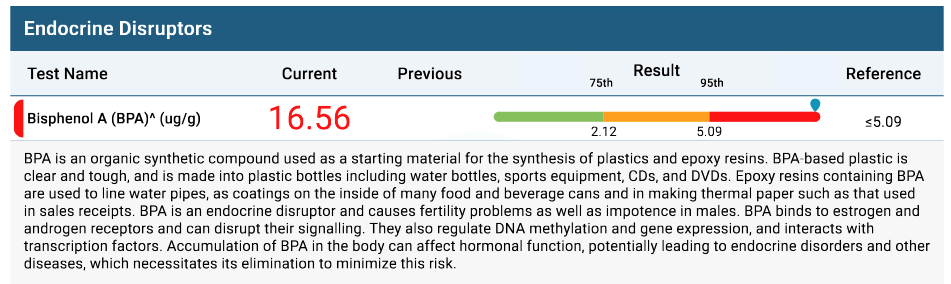
BPA in microplastics is known as a forever chemical, and it can then accumulate in the fat cells of our bodies and also in our brain. So below, I have done a deep dive into the scientific literature to see which foods, supplements and lifestyle hacks you and I need to prioritise to help clear these pesky BPAs faster than they are able to come in.
Get our lovely Healthy Bites newsletter each week!
Each week, you’ll get an amazing recipe, a useful health tip, and an ingredient to jazz up your shopping basket! We don’t share your details with anyone else.
How our body naturally detoxifies and how to optimise it
The BPA we ingest through food and drink is rapidly absorbed through the gut, and the liver is the key organ that helps clear it efficiently in most people. However, skin exposure to BPA through plastic in underwear and activewear may bypass the liver, allowing it to circulate in the body in its active form for longer, potentially increasing its endocrine-disrupting effects.
Also, some people genetically find it harder to clear BPA from their system than others, and this is where it can accumulate and cause havoc on the body. These include the genetic SNPs UGT2B15, UGT1A9, UGT1A1 and the sulfation SNP SULT1A1.
If you are prone to accumulating BPA then it is vital to learn about the nutrients involved that can optimise our natural detoxification pathways and this is where your liver, kidneys, gut function, skin and even your brain all need support.
The liver – our detox powerhouse
The liver uses a clever process called glucuronidation, where it bonds BPA onto a sugar molecule called glucuronic acid to make it water-soluble. This means the BPA can be safely sent off to the kidneys and then flushed out in your urine, and most BPA is neutralised before it reaches general circulation. However, some people are not able to activate glucuronidation as efficiently as others due to certain genetic factors, other liver issues, or exposure to high levels of BPA.
For instance, one study found that BPA glucuronidation efficiency was reduced by 11 per cent for autistic people and by 17 per cent for those with ADHD compared to controls. Reduced efficiency of BPA glucuronidation has also been found in people diagnosed with Parkinson’s disease.
And that is why some people need to prioritise eating certain foods and supplements to give their glucuronidation a helping hand. Here are my top tips:
- Eat plenty of cruciferous vegetables such as broccoli, kale, cauliflower, cabbage, rocket and Brussel sprouts.
- Milk thistle is a hug for the liver and can help to enhance glucuronidation.
- Turmeric is not only anti-inflammatory, but it also supports liver function.
- Ensure you are getting enough magnesium and B vitamins in your diet or through your supplement routine to optimise glucuronidation.
The kidneys – the way we excrete BPA
Once BPA goes through the glucuronidation process in the liver, it is passed to the kidneys and then eliminated from the body through our urine. So, we flush them out more efficiently when we adopt the following habits:
- Stay well-hydrated by drinking lots of filtered water (ideally from stainless steel or glass water bottles).
- Eat kidney-friendly foods, such as celery, cucumber, carrot, watermelon, coconut water and parsley.
- Support your efficient kidney health with herbal teas and supplements like nettle and dandelion.
The gut – to enhance liver function
Don’t forget the gut! A healthy microbiome helps to regulate and prevent BPA absorption and also supports your liver detoxification pathways.
- Probiotic strains such as Lactobacillus casei and Bifidobacterium breve have been found to bind BPA and escort it out of the gut during bowel movements.
- Also choose prebiotic foods such as chicory root, underripe (green) bananas and Jerusalem artichokes to feed these helpful and friendly microbes.
The skin – sweat it out
BPA doesn’t only leave our body through urine; it can also be excreted through perspiration.
- That’s why fun, sweaty physical activities such as dancing, trampolining and running help us to sweat out the bad stuff.
- Sauna sessions, especially infra-red saunas, can be a brilliant relaxing way to help create a sweat, and regular saunas can be a gentle and natural way to help the body to release stored toxins.
The brain – yes, they can lurk there too
BPA can also cross the blood-brain barrier, which is worrying. This is because it binds to oestrogen receptors in the brain, leading to oxidative stress and inflammation. The brain doesn’t have the same efficient detox tools as the liver, so we need to support it differently through the following:
- Antioxidants such as N Acetyl Cysteine, Glutathione, Alpha Lipoic Acid, Co-enzyme Q10 and Quercetin can help mop up oxidative stress, even in the brain. Green tea, particularly its antioxidants called catechins, can protect against BPA-induced damage.
- Also prioritise eating anthocyanin-rich foods, as the blue, purple and red pigments in fruits and vegetables such as berries, pomegranate, beetroot and red onions, all of which may help reduce the negative effects of BPA.
- Omega-3s from a good-quality microplastic-free fish oil supplement, as well as flaxseeds, can also support brain cell membranes and reduce inflammation.
- It is vital to prioritise sleep, too, as deep sleep activates the brain’s glymphatic system, its housekeepers that help clear toxins overnight.
Round up
We live in a world where microplastics and BPA are extremely hard to avoid, but that doesn’t mean we are powerless, and we do not need to roll over and let them hijack our health. Our bodies are wonderfully equipped with natural detoxification pathways, and with a little help from nourishing foods, targeted supplements and smart lifestyle tweaks, we can support these systems to safely escort these disruptive chemicals out.
From the liver’s clever glucuronidation process to the brain’s need for antioxidant protection, every part of the body plays a role. And when we bring in the right allies like milk thistle, broccoli and blueberries to help, and also prioritise deep sleep, we’re not just detoxing, we’re building resilience to microplastic disruption.
If you are curious to explore whether BPA or other endocrine-disrupting chemicals are affecting your hormones, or your overall health, our clinical team at NatureDoc can organise a full urinary hormone panel and environmental toxin screen. We can then work one-to-one with you to create a personalised programme to help correct any imbalances, help you feel your best, and protect your future health.
References
- Human exposure to Bisphenol A in Europe
- Biomonitoring – Bisphenol A (BPA)
- Effects of Bisphenol A and its Analogs on Reproductive Health: A Mini Review
- Phthalates and other additives in plastics: human exposure and associated health outcomes
- Bisphenol A and Reproductive Health: Update of Experimental and Human Evidence, 2007–2013
- Oxidative Stress and BPA Toxicity: An Antioxidant Approach for Male and Female Reproductive Dysfunction
- Natural Products in Mitigation of Bisphenol A Toxicity: Future Therapeutic Use
- Modulation of Metabolic Detoxification Pathways Using Foods and Food-Derived Components: A Scientific Review with Clinical Application
- EWG – BPA Coats Cash Register Receipts
- Clinical Effects of Regular Dry Sauna Bathing: A Systematic Review
- Effects of Microplastic Exposure on Human Digestive, Reproductive, and Respiratory Health: A Rapid Systematic Review
- Environment and women’s reproductive health
- Phthalates and other additives in plastics: human exposure and associated health outcomes
- Landmark study links microplastics to serious health problems
- Prevalence of microplastics in commercially sold soft drinks and human risk assessment
- Mechanistic insight into potential toxic effects of microplastics and nanoplastics on human health
- Thyroid effects of endocrine disrupting chemicals
- Exploring the potential protective role of anthocyanins in mitigating micro/nanoplastic-induced reproductive toxicity: A steroid receptor perspective
- Bioaccumulation of microplastics in decedent human brains
- Bisphenol-A and phthalate metabolism in children with neurodevelopmental disorders
- Associations between Exposure to Bisphenol A and Behavioral and Cognitive Function in Children with Attention-deficit/Hyperactivity Disorder: A Case-control Study
- Association of bisphenol A, bisphenol F, and bisphenol S with ADHD symptoms in children
- Association of bisphenol A with cognitive functions and functionality in adult attention deficit hyperactivity disorder
- Prenatal and early childhood bisphenol A concentrations and behavior in school-aged children
- Exposure to bisphenol A and behavior in school-age children
- Does Bisphenol A (BPA) Exposure Cause Human Diseases?
- Prenatal exposure to bisphenol A and autistic- and ADHD-related symptoms in children aged 2 and5 years from the Odense Child Cohort
- Does Bisphenol A Confer Risk of Neurodevelopmental Disorders? What We Have Learned from Developmental Neurotoxicity Studies in Animal Models
- Effect of bisphenol A on the neurological system: a review update
- Impact of BPA on behavior, neurodevelopment and neurodegeneration
- Bisphenol A glucuronidation in patients with Parkinson’s disease
- Effects of Endocrine-Disrupting Chemicals on Bone Health
- A Review on the Effects of Bisphenol A and Its Derivatives on Skeletal Health
- Preliminary investigation into the impact of BPA on osteoblast activity and bone development: In vitro and in vivo models




Responses